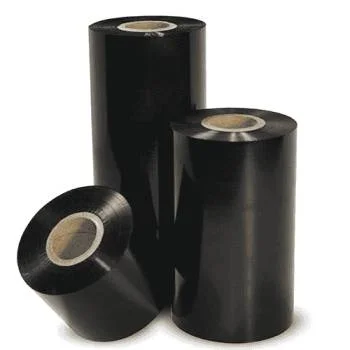
The Mechanics of Thermal Transfer Ribbon Chemistry
Thermal transfer ribbons (TTR) are precision consumables composed of a ultra-thin polyester carrier film (typically 4.5 microns thick), a release coat, a pigmented ink matrix, and a proprietary static-dissipative silicone backcoat. The choice of ink matrix—pure wax, wax-resin hybrid, or synthetic full resin—determines the optical density, scratch resistance, chemical tolerance, and required printhead heat energy.
1. Standard & Resin-Enhanced Wax Ribbons
Wax ribbons are formulated using refined paraffin and microcrystalline waxes blended with carbon black pigments. They represent the most economical thermal printing consumable for standard industrial paper stocks.
- Printhead Energy: Low heat settings required. Melting temperature ranges between 65°C and 75°C.
- Print Speed Capability: Up to 10 to 12 inches per second (IPS) on industrial print engines (Zebra ZT411, TSC MH240).
- Matched Substrates: Chromo art paper, coated paper tags, uncoated vellum, and TT2C paper.
- Durability Profile: Moderate abrasion resistance. Susceptible to smearing if subjected to severe friction, water immersion, or solvent contact.
- Typical Applications: Warehouse shipping labels, outer carton distribution barcodes, retail price tags, and inventory bin markers.
2. Wax-Resin Hybrid Ribbons
Wax-resin ribbons combine high-grade synthetic acrylic resins with refined waxes in approximately equal proportions. The resin component provides enhanced chemical bonding and surface hardness, while the wax component maintains low-to-medium melting temperatures.
- Printhead Energy: Medium heat settings required. Melting temperature ranges between 75°C and 85°C.
- Print Speed Capability: Up to 8 to 10 IPS with sharp 90-degree rotated ladder barcodes.
- Matched Substrates: Supercalendered papers, coated synthetics, polypropylene (BOPP), polyethylene, and top-coated vinyl films.
- Durability Profile: High resistance to scratching, surface smudging, moisture, and mild domestic cleaners.
- Typical Applications: Pharmaceutical packaging labels, healthcare diagnostic samples, frozen food carton tracking, and retail apparel tags.
3. Pure Full Resin Ribbons
Full resin ribbons feature an ink formulation consisting entirely of advanced synthetic polymers and cross-linking agents. When thermal printhead elements transfer resin ink to synthetic facestocks, the polymers fuse chemically with the film substrate, forming an indelible bond.
- Printhead Energy: High heat settings required. Melting temperature ranges between 90°C and 110°C.
- Print Speed Capability: 4 to 6 IPS for maximum edge resolution.
- Matched Substrates: Matte white and silver polyester (PET), polyimide (Kapton), polyvinyl chloride (PVC), and acetate.
- Durability Profile: Complete immunity to industrial alcohols, engine oils, brake fluid, sulfuric acid vapors, and continuous high-temperature exposure (-40°C to +180°C).
- Typical Applications: Automotive under-hood wiring labels, printed circuit board (PCB) tracking, industrial asset rating plates, and chemical drum compliance stickers.
4. Wash Care Textile Resin Ribbons
A specialized sub-category of full resin ribbons, wash care TTR is engineered specifically for textile fabric tags including nylon taffeta and woven polyester satin. The transferred resin withstands boiling water laundering cycles, steam ironing, and dry-cleaning perchloroethylene solvents without fading or bleeding.
Ribbon Slitting & Core Standards
Advantech Solutions slits all thermal transfer ribbon formulations at our Mayapuri Phase II plant in New Delhi. We provide ribbons in widths from 30mm to 220mm, lengths of 74m, 110m, 300m, and 450m on 0.5-inch and 1-inch ID cores in both Ink-Side Out (CSO) and Ink-Side In (CSI) configurations.